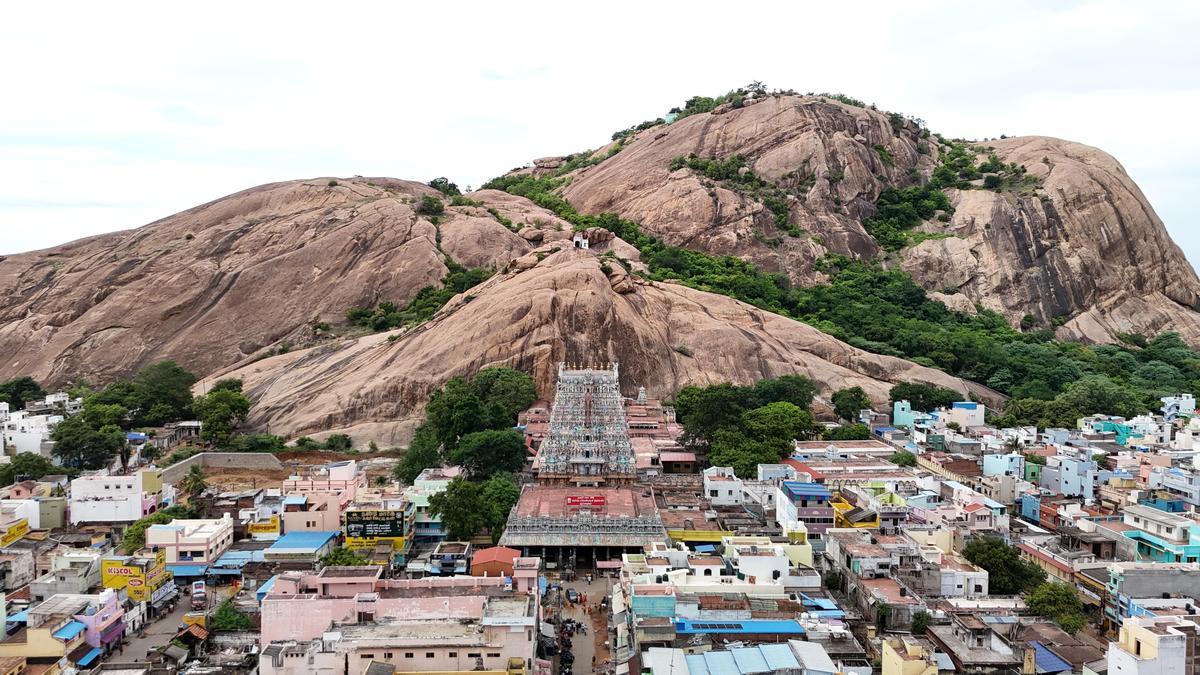
The Tamil Nadu government on Tuesday asked the Supreme Court to stay a Madras High Court decision of January 2026 confirming an earlier order directing the Arulmigu Subramaniswamy Temple devasthanam to light the Karthigai Deepam on a stone pillar atop Thirupparankundram Hill. Appearing for the State, senior advocate Shekhar Naphade submitted before a Bench of Justices Aravind Kumar and Vipul M. Pancholi that the fear of disturbance of public peace was real and that status quo must remain until the State's appeal against the January order is decided. The hearing, which lasted over an hour, will resume on November 18.
The High Court's Division Bench had upheld the Single Judge order while dismissing the State's concerns as an "imaginary ghost", given the pillar's proximity to a dargah. Mr. Naphade argued that the petitioner wanted to light the lamp on the side of the dargah rather than the temple, and that the High Court order would upset this "natural division", creating potential for disturbance of public peace.
Senior advocate Jaideep Gupta, for the Commissioner of the Hindu Religious and Charitable Endowments (HR&CE) Department, argued that claims of a "custom" of lighting the Karthigai Deepam on the Deepathoon made by the Hindu Dharma Parishad were "calculated to occasion a breach of peace upon a sensitive site with a recorded history of communal tension". He submitted that no established practice or prior claim existed, and that the lamp had been lit only at the Deepa Mandapam for over 150 years. Senior advocate Gopal Sankaranarayanan, for the Madurai District Collector, said the word "Deepathoon" did not arise at any point before 2025.
A recent HR&CE affidavit in the apex court said the conduct of daily poojas, festivals and customary rituals, including the manner and place of lighting the Karthigai Deepam, fell within the exclusive domain of the temple administration under the Agamas, the opinion of the Sthanikars and the 1959 Act, and not with any private association. It said the temple's ownership of the Hill had been settled by a 1923 court decision, except for certain areas including the steps leading up to the mosque and the top of the rock on which the mosque and the flag-staff of the Muslims stood.