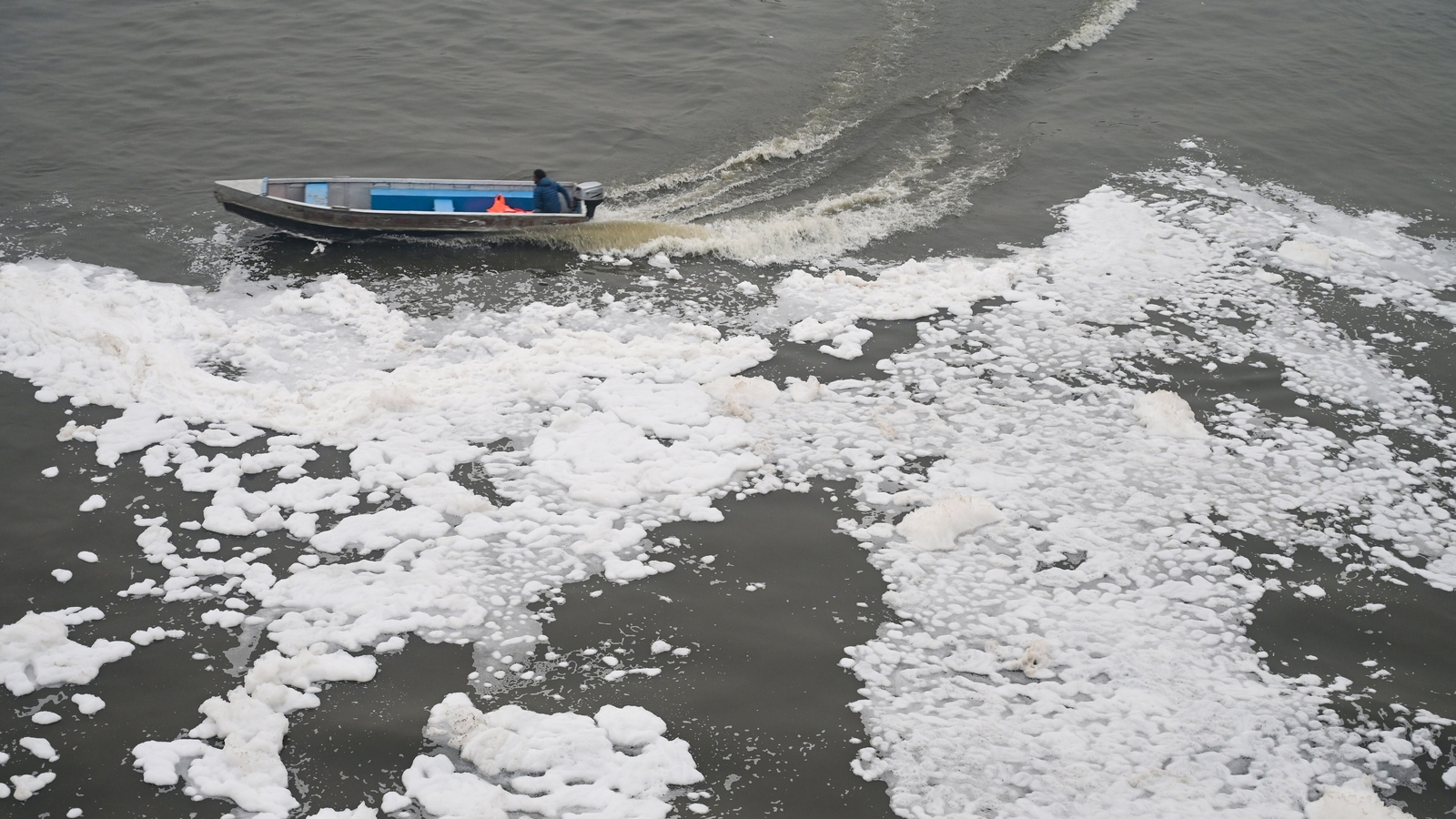
The Supreme Court has ruled that states, Union territories and individual districts can be fined if the Yamuna's water quality deteriorates on any parameter while passing through or exiting their jurisdiction, with the penalty amount to be deposited in the court's registry. A bench of justices Manoj Misra and Manmohan said those responsible would be held accountable, and asked the Central Pollution Control Board (CPCB) to propose a formula for calculating the penalty. States and UTs may recover the amount from polluters and officials found remiss after an inquiry, according to the detailed order released on Monday.
The court has laid down a framework for monitoring water quality at the entry and exit points of every state, UT and district along the river. It also prescribed steps to ensure sewage treatment plants and common effluent treatment plants run efficiently, industrial waste is checked at source and untreated wastewater is kept out of the river. The order could have significant implications for Delhi, where the Yamuna covers a 22-km stretch between Wazirabad and Okhla—about 2% of the river's length—but contributes the most to its pollution load.
The bench observed that the river's poor health reflected the failure of civic administration in towns, cities and villages along its banks, and noted that pollution had risen despite large sums spent on cleaning it. It said industrial pollution and untreated sewage must be curtailed at source, and that illegal colonies, JJ clusters along drains and settlements on the riverbed would have to be removed after rehabilitation of eligible occupants. It also flagged illegal and unaccounted-for dairies, particularly in Delhi.
The court called for treating the Yamuna as one continuous ecosystem rather than a collection of state-wise stretches, invoking the principle of "common, but differentiated responsibilities". It directed the CPCB to submit water quality data, including biochemical oxygen demand, chemical oxygen demand, faecal coliform and total suspended solids, at boundary points, and suggested independent verification by institutions such as the IITs. It also ordered tamper-proof smart energy meters at treatment facilities. The river flows through Uttarakhand, Himachal Pradesh, Haryana, Delhi and Uttar Pradesh.