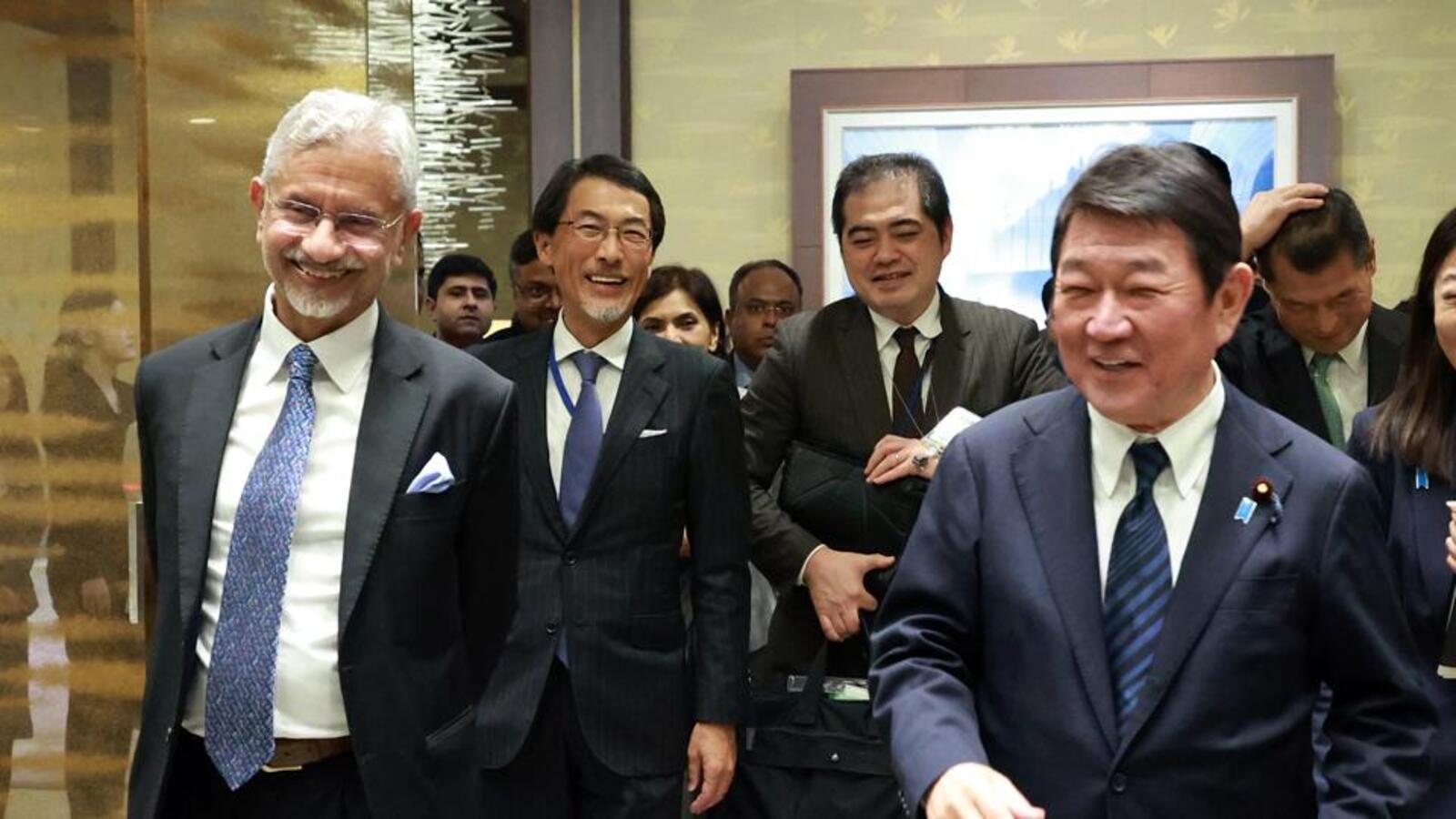
India and Japan on Thursday pledged to uphold a free and open world order amid what they described as an increasingly severe global security environment, deepening cooperation in defence, technology, economic security, digital connectivity and the security of AI systems. The commitments came at the fourth 2+2 dialogue in Tokyo between defence minister Rajnath Singh and external affairs minister S Jaishankar and their Japanese counterparts, Shinjiro Koizumi and Toshimitsu Motegi.
A joint statement issued after the meeting, held hours before a summit of the leaders of China, Russia and the US in Shenzhen, opposed any attempt to unilaterally change the status quo without directly naming China. It expressed grave concerns over economic coercion, including arbitrary export restrictions and non-market policies and practices, and backed a fair competitive global environment and resilient supply chains. Singh said the relationship was important for peace and prosperity in the Indo-Pacific, while Motegi said the two countries should serve as an anchor for regional stability.
The talks made progress on air and space domain awareness, a proposed information-sharing agreement and collaboration on underwater and missile technologies. Singh sought early consideration of an agreement to transfer Japan's Unified Complex Radio Antenna (Unicorn) system to the Indian Navy, and pressed for the early conclusion of a maritime ship repair arrangement with reciprocal facilities. The two sides decided to accelerate coordination for a letter of intent allowing Japan's Self-Defence Forces to use Indian firing ranges for live-fire training, including surface-to-ship missiles, and agreed to make bilateral exercises more complex.
Jaishankar said the value of the trusted India-Japan partnership has increased as the world order faces multiple shocks, including two major conflicts and growing economic volatility, and that the cooperation seeks to support a multipolar Asia and a multipolar world. The ministers also agreed to strengthen cybersecurity cooperation, including AI-enabled cybersecurity, and to enhance cooperation on trusted undersea cable networks. They further agreed to hold a dialogue between consular authorities and a table-top exercise on helping Indian and Japanese nationals abroad.