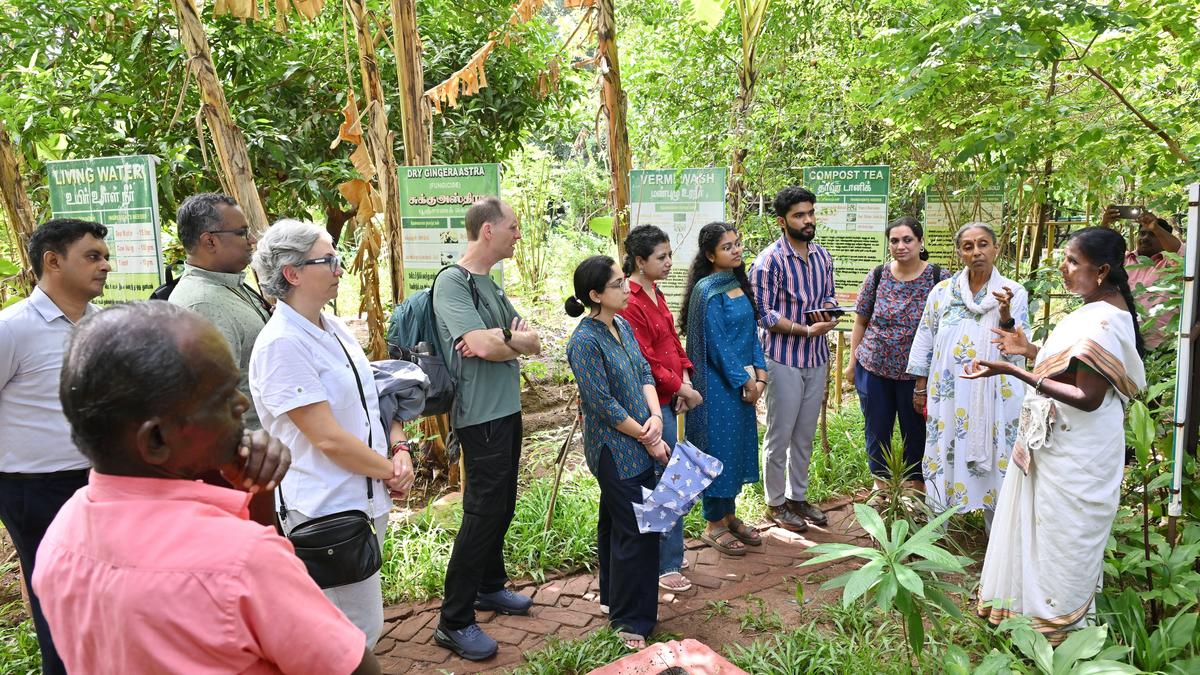
A group of experts from IIT-Madras and the University of Birmingham visited an eco-farm in Chengalpattu district on Monday to look for community models of sustainability practices. At the farm, the visitors were introduced to methods such as rainwater harvesting, solar energy sources, fish farming using rainwater, cultivation of native medicinal herbs, bee-keeping and various uses of the native vetiver grass, from erosion control to essential and aromatic oils and the weaving of household items such as mats and curtains.
Sudhir Chella Rajan, Professor in the Department of Humanities and Social Sciences at IIT-Madras, said the institution was exploring ways to build forms of activity around what he called "just sustainabilities". Describing the approach as adaptive governance, he said the idea is to seek out sustainable practices among communities in a peri-urban setup and find out how academics can collaborate. He said that if the "20 km by 20 km stretch – Muthukadu-Kovalam region right along OMR and ECR" is in crisis and various things are changing, the challenge is to make that change sustainable, especially in the context of climate change, with severe storms and flooding issues affecting the area.
Charuta Kulkarni of the School of Sustainability at IIT-M said that when environmental systems are managed, ecological and social systems are often dealt with independently rather than as a composite system. She said the idea behind the IIT-M and University of Birmingham project is to think of new things and learn from each other, and that peri-urban spaces were taken up as a kickstarter. David M. Hannah, deputy pro-vice chancellor (Sustainability) and director of the Birmingham Institute of Sustainability and Climate Action, said indigenous local knowledge could be incorporated to create appropriate resources to understand how to make changes in the environment.
Shantha Sheela Nair, a retired IAS officer who runs the Eco Park Information Centre – Sustainability Solutions (EPIC-SS) on a six-ground plot of ancestral land, recalled the days when the area barely had groundwater. She said the journey from there to a self-sufficient, sustainable farm had been arduous and fulfilling at the same time. She recalled burying her dog, to whom she was attached, on the land, and said it was then that she thought of doing something there and started a millet farm, with one thing gradually leading to another.