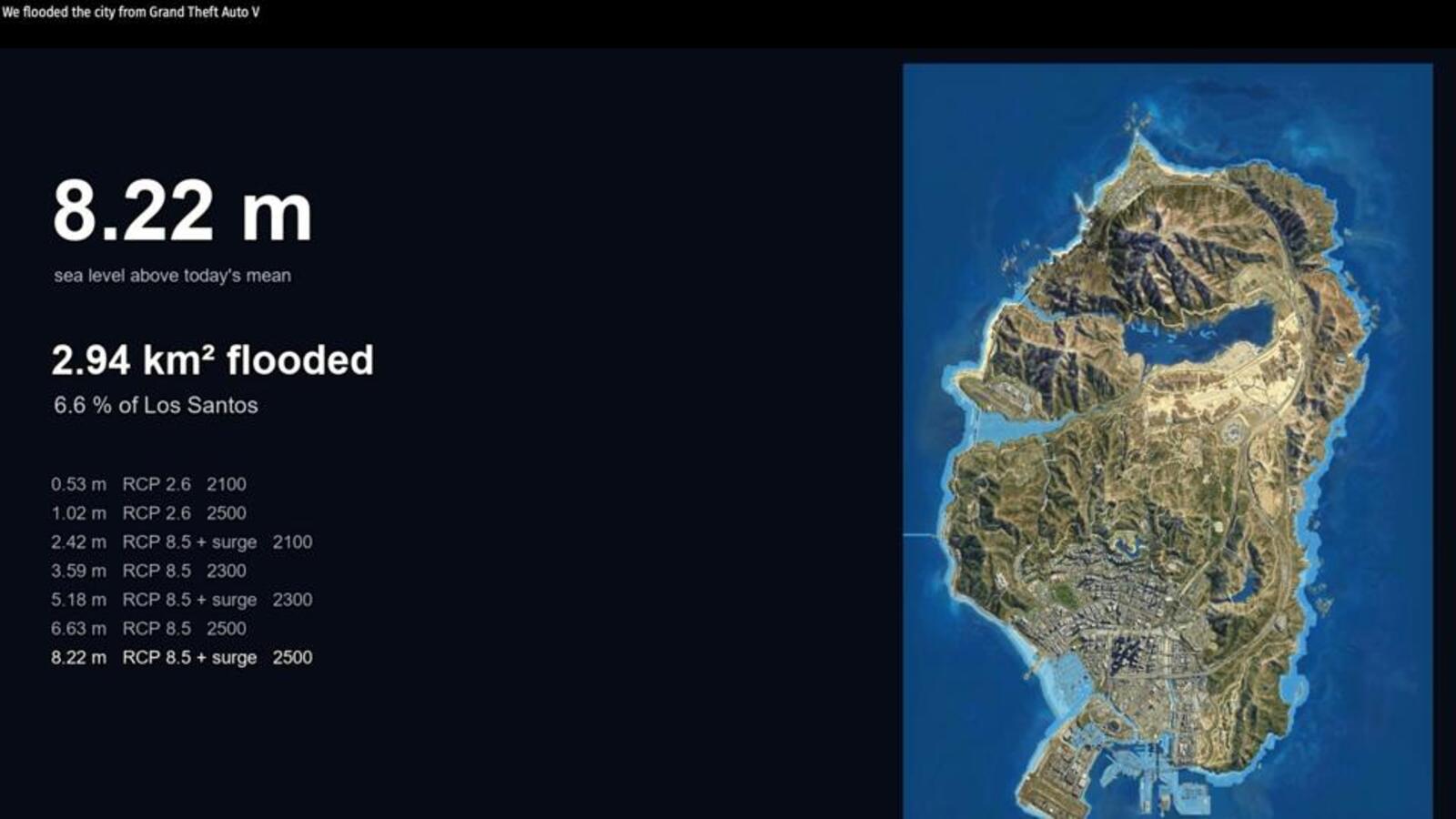
Researchers at the University of Potsdam and the Alfred Wegener Institute have used the fictional city of Los Santos in Grand Theft Auto V to simulate the effects of rising sea levels, according to a study by Paul Nörenberg and Hugues Lantuit. The paper coincides with the launch of the GTA VI video game. The scientists say Los Santos serves as an ideal case study because it closely replicates the real Los Angeles, allowing a direct comparison of simulated flood outcomes.
The study draws on two Representative Concentration Pathway scenarios from the Intergovernmental Panel on Climate Change Fifth Assessment Report. Under the RCP 8.5 scenario with storm surges, combined sea levels are projected to reach 5.18 m by 2300, with the model showing 5.1 per cent of the mapped land area inundated. For a 2500 scenario with projected sea levels of 8.22 mm, modelled inundation rises to 6.5 per cent, placing the port, wastewater infrastructure and coastal energy facilities at risk. Under the RCP 2.6 mitigation scenario, the model shows 2.2 per cent of land area inundated at 2300 with storm surge, with no major infrastructure affected.
Since Rockstar does not release raw terrain data, the scientists used a fan-built 3D model of the map, pinned it to coordinates with 11 control points and set the sea level from 31 shoreline points, checking it by flying an in-game helicopter along the coastline. The height was calibrated against the game's Mount Chiliad. They then simulated the IPCC scenarios for 2100, 2300 and 2500, each topped with a 1.59-metre storm surge, the highest Los Angeles has ever recorded. When overlaid on real maps and flood studies for Los Angeles, the same districts stood most exposed.
Nörenberg, the lead author, said games can now reproduce real-world locations almost true to life, and that players familiar with a virtual landscape can engage emotionally with the effects of climate change. The scientists recommend the approach as a template for geoscience communication using open-world game environments, with the explicit caveat that the static inundation model and its limitations must be communicated transparently to every audience, and that the 2300 and 2500 horizons remain the weakest part of the scenario set.