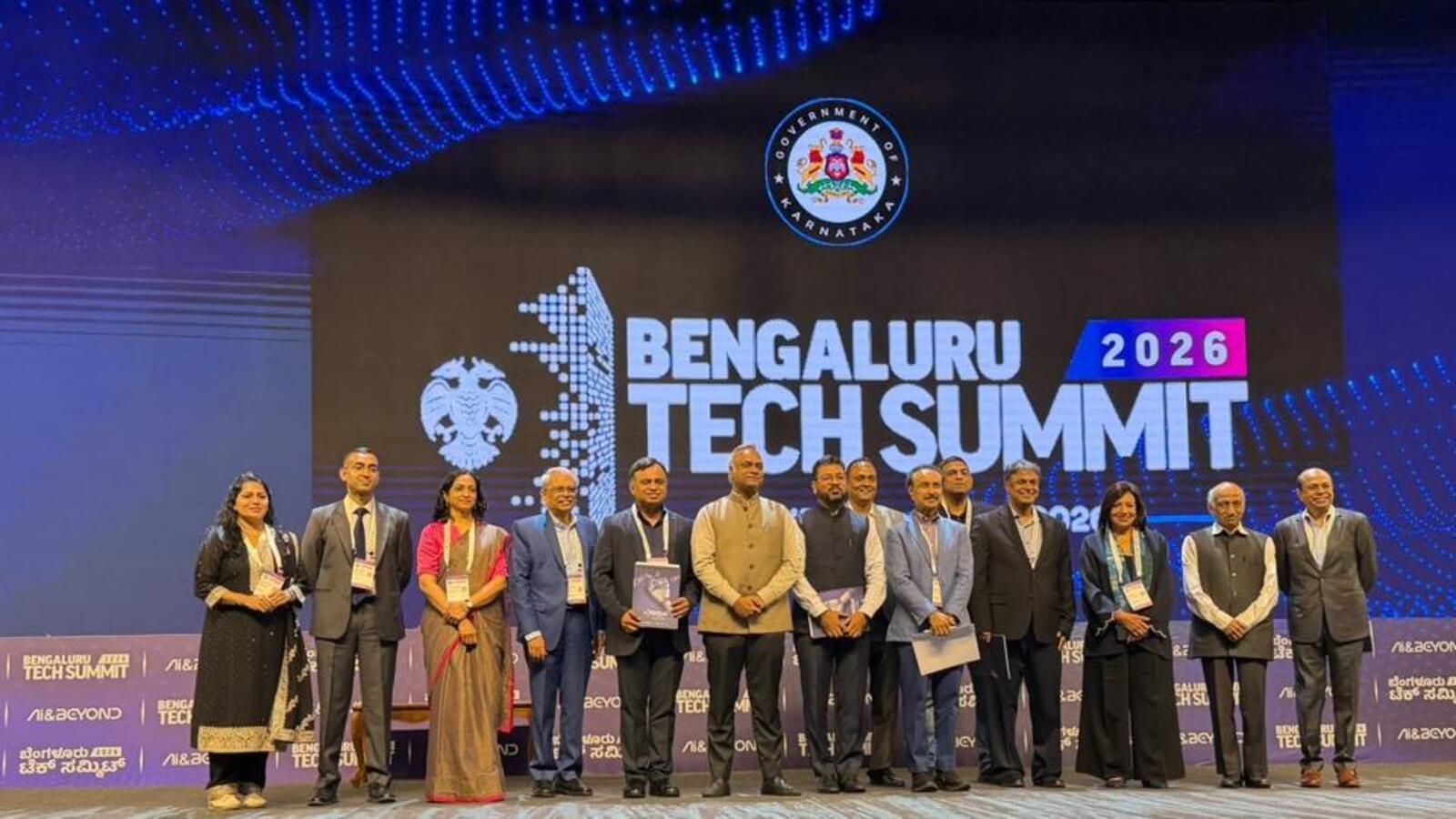
Gnani AI, a start-up selected to build sovereign foundational AI models under the India AI Mission, signed a memorandum of understanding (MoU) with the Karnataka government on Tuesday to train 1,000 engineering and science students in voice AI and agentic AI engineering. The MoU was signed with the state's Department of Electronics, Information Technology and Biotechnology at the Bangalore Tech Summit 2026.
The programme will cover modules on multilingual speech recognition, text-to-speech, language models, conversational AI, prompt engineering, API integration, retrieval-augmented generation (RAG) and multi-agent systems. Training will be hands-on, with graded labs and capstone projects in which students build and deploy multilingual voice agents and AI agents for enterprise use. Gnani will give students access to its AI models, platforms, development tools and computing resources, supported by instructor-led sessions, teaching assistants and mentorship from the company's engineers.
"We are committed to nurturing future-ready talent through hands-on learning in Voice AI and Agentic AI," said Ganesh Gopalan, co-founder and CEO of Gnani AI. "Through access to our AI platforms, tools and technical mentorship, we hope to bridge the gap between academic learning and industry requirements," he said.
Founded in 2016, Gnani was selected after the IT ministry reviewed more than 500 proposals under the India AI Mission. The company has launched Inya VoiceOS, which it calls India's first 5-billion-parameter voice-to-voice foundational AI model, unveiled by Prime Minister Narendra Modi at the India AI Impact Summit in New Delhi in February. It has also launched Evon, a 30-billion-parameter large language model that Gnani says is more accurate than much larger models on MILU, a benchmark for Indic-language understanding; that claim has not been independently verified. Gnani said a larger speech-to-speech model, called Warp, is in development. Separately, it has released Prisma v3.0, a speech-to-text model handling nine Indian languages and Indian English, and Timbre v3.0, a text-to-speech model that lets users direct how expressive the voice sounds.