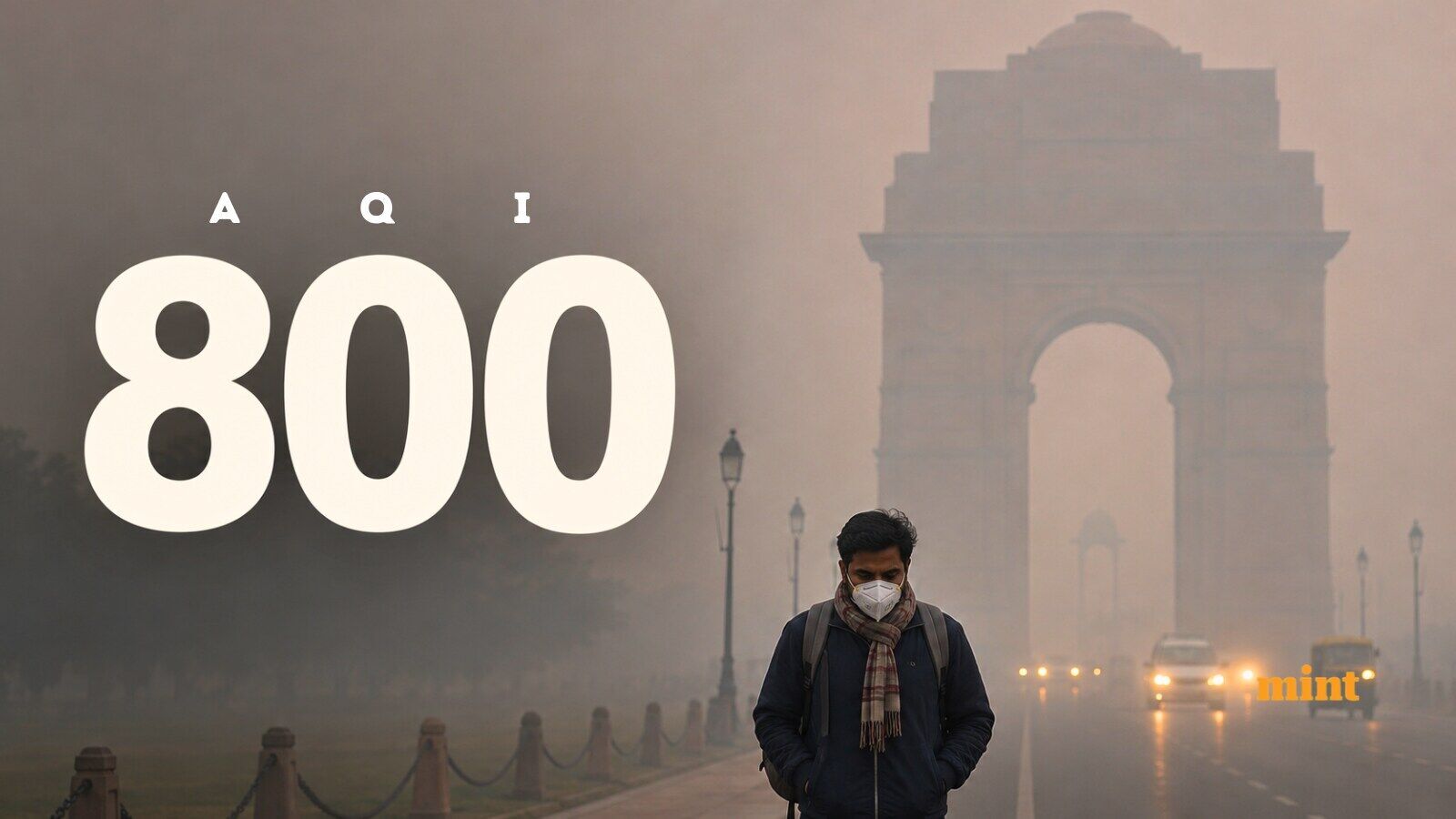
Delhi's live Air Quality Index stood at 800 on November 16 at 7:31 AM, classified as "hazardous" on the US AQI scale by the AQI.in dashboard, which reported smoky haze, a temperature of 19°C, 58% humidity and wind speed of 7.2 km/h. PM2.5 was recorded at 476 micrograms per cubic metre, with PM10 higher at 666 micrograms per cubic metre and flagged with an alert symbol. Carbon monoxide measured 1,475 parts per billion, nitrogen dioxide 17 parts per billion, sulphur dioxide five and ozone three on the same scale.
The dashboard's November calendar showed hazardous readings on each of the first 14 days, with the AQI climbing from 306 on November 1 to 461 on November 6 and reaching 666 on November 9. Six straight days above 400 were followed by a fall to 346 on November 11, a rise to 547 on November 12, 452 on Friday and 435 on Saturday, before Sunday's reading fell to 284, still in the severe category. Monday's 800 came from live readings, with the daily average awaited.
AQI.in flagged a high risk of symptoms from asthma and heart problems, listing wheezing, chest tightness, persistent coughing and shortness of breath, while its heart panel listed chest pain, severe tiredness, irregular heartbeats and difficulty breathing.
In the live India ranking, Rohtak topped with an AQI of 1,125, followed by Hisar at 1,038, Bhiwani at 1,025, Sirsa at 904 and Sonipat at 810, with Haryana holding the first five spots and seven of the top 10. New Delhi ranked sixth nationally, 325 points below Rohtak, followed by Faridabad at 795, Gurugram at 750, Noida at 714 and Bathinda at 700. Delhi also had the highest AQI among eight metros, ahead of Kolkata at 219, Mumbai at 191, Bengaluru at 189, Hyderabad at 185, Ahmedabad at 174, and Chennai and Pune at 173 each. The city dashboard placed New Delhi sixth in its global ranking.