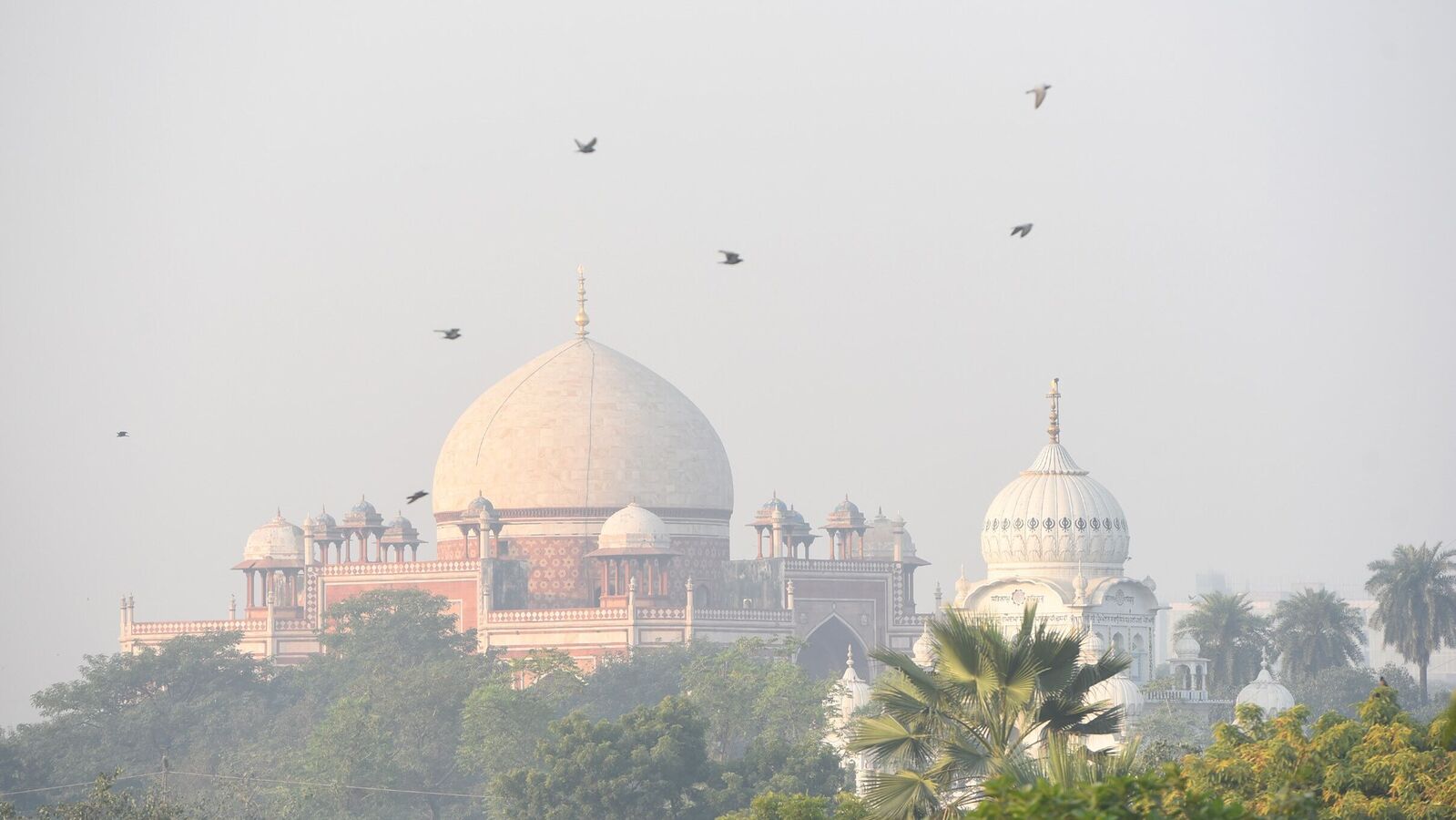
Delhi's air quality index deteriorated to 454 on Saturday morning, 28 November, according to AQI.in data, placing it in the 'hazardous' category. The reading, recorded at 6:51 AM, was close to the seven-day peak of 449 logged at 6 AM on 21 November. The capital's AQI had fallen to 144 at 3:01 PM on Friday before climbing again in the evening; it crossed 300 around 7:30 PM and stayed above 400 after midnight.
At 6:11 AM on Saturday, Delhi's PM10 level was 428 micrograms per cubic metre, far above the World Health Organization's 24-hour guideline of 45 micrograms per cubic metre. Carbon monoxide stood at 3,395 ppb, nitrogen dioxide at 25 ppb, sulphur dioxide at nine ppb and ozone at two ppb. The temperature was 25°C, humidity 30%, wind speed 3.6 km/h and the UV index 3.1. According to AQI.in, Bettiah in Bihar recorded the worst air quality in the country at 682, followed by Ghazipur at 558, Saharsa at 488 and Srinagar at 480.
Vehicular emissions were the largest contributor to PM2.5 pollution in real-time source apportionment estimates for Delhi between 1 AM and 9 AM on Friday, accounting for 32% of the estimated load, according to AQI.in. Biomass burning followed at 22.8%, secondary organic aerosols at 14% and secondary inorganic pollutants at 12.3%. Waste burning contributed 10.7%, industrial emissions 4.2%, mineral dust and ash 1.8%, coal combustion 1.5% and mixed combustion 0.8%.
Of the 57 monitoring stations that recorded data on Friday, 36 were in the 'poor' category, 17 in the 'moderate' category and four in the 'very poor' category, per AQI.in. The station at Terminal 3 of the Indira Gandhi International Airport reported the worst air quality at 346. AQI.in follows the US AQI scale, while the Central Pollution Control Board classifies 0-50 as 'good', 51-100 as 'satisfactory', 101-200 as 'moderate', 201-300 as 'poor', 301-400 as 'very poor' and 401-500 as 'severe'.