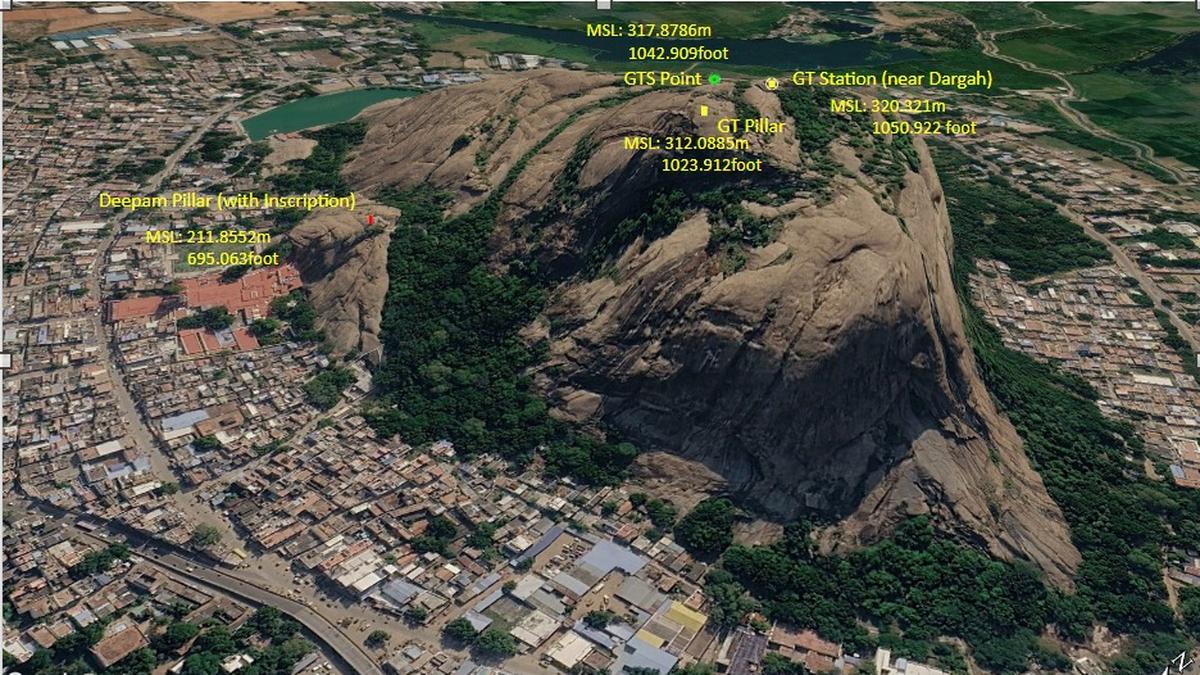
A 2026 report by the Survey and Settlement and Archaeology Departments of the Tamil Nadu government has identified the pillar near the Sikandar Badusha Dargah on Thirupparankundram hill as a Great Trigonometrical Survey (GTS) pillar erected by the British, according to the findings. The report states that triangulation bearings taken from the Sikandarmalai hill station to other stations in the present survey are consistent with values in the colonial-era GTS report, suggesting the pillar and the associated station marks engraved on the rocky surface are a survey pillar.
The map prepared by the departments identifies the original Deepathoon (lamp pillar) as being below the dargah. The findings have drawn interest amid the dispute over the lighting of the Karthigai Deepam atop the hill, following the Supreme Court's decision to permit the lighting of the lamp at the newly identified deepathoon as a limited, one-time arrangement.
The five-volume report, running over 1,800 pages, identified more than 800 stations in the first phase of the survey, of which 484 stations — 210 primary and 274 secondary — were physically documented. Thirupparankundram was a secondary station with a stone pillar and stone mark. The exercise was based on an order issued by the Revenue and Disaster Management Department in December 2025 to systematically identify and document all GTS stations, with permission to publish the report granted in August 2026.
According to the order, survey stations and control points were historically marked on GTS maps, topo sheets and village maps and served as anchors for cartography and land management, but many original physical station points became untraceable over time due to urbanisation, terrain change, industrialisation and human vandalism. The Director of Survey and Settlement proposed a comprehensive field exercise to identify, map, document and preserve all GTS stations in the State and to use their coordinates for subsequent surveys.