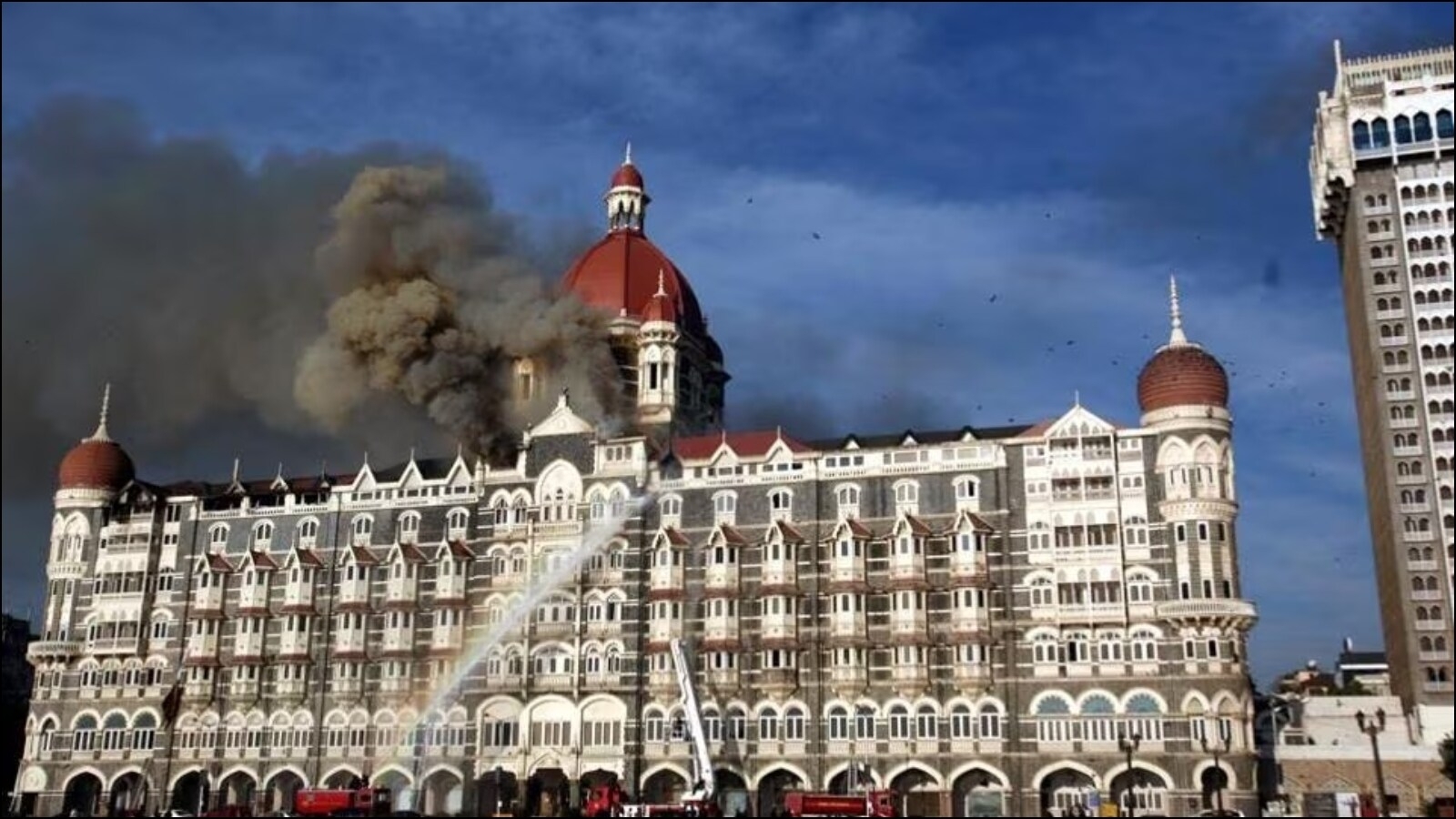
On the night of November 26, 2008, ten armed men from the Pakistan-based terror group Lashkar-e-Taiba launched a coordinated assault on Mumbai, turning the Taj Mahal Palace Hotel, the Oberoi-Trident, Chhatrapati Shivaji Terminus (CST) railway station, the Leopold Café and Nariman House into battlegrounds. According to investigators, the terrorists set sail from Karachi on November 21 and hijacked an Indian fishing boat near the coast on November 23, killing four crew members; they spared the captain so he could steer them to Mumbai, and killed him too about 7 km off the coast. Then-home minister P Chidambaram told the Lok Sabha that the terrorists landed near Budhwar Park in Colaba between 8:00 and 8:30 pm on November 26 and broke into teams.
The NIA told the Supreme Court that at about 9:15 pm, the first pair, Ajmal Kasab and Ismail Khan, walked into the packed CST station and opened fire, leaving at least 58 dead and more than 100 wounded. Two gunmen attacked diners at the Leopold Café with grenades and gunfire, killing 11, while timer bombs hidden in two taxis near the café killed five others, the investigations revealed. Another group blasted a petrol pump and laid siege to a Jewish outreach centre at Nariman House, where six Israelis lost their lives, reports said. At around 9:45 pm, terrorists entered the Taj Mahal Palace and Tower Hotel and opened fire on guests and staff, while a separate group stormed the Oberoi-Trident, opened fire, set off explosives and took hostages; at least 35 people were killed inside that hotel, the NIA told the Supreme Court.
Mumbai Police were the first to respond, rushing in to evacuate civilians. Kasab and Khan slipped into Cama Hospital at around 11 pm, where staff locked the patients' wards; a police team fought a fierce battle on the upper floors and two policemen were killed. The two terrorists then fled and ambushed a police vehicle, killing six policemen, including Mumbai Anti-Terrorism Squad chief Hemant Karkare, Additional Commissioner Ashok Kamte and police officer Vijay Salaskar. They hijacked a police vehicle but were intercepted; Khan was killed in the gunfight and officer Tukaram Omble lost his life trying to disarm Kasab, who was taken into custody. Past midnight, a massive blast tore through the Taj and fire swept into its central dome.
By the time the guns fell silent after 60 hours, nine of the 10 terrorists were dead and 166 people had been killed, including 20 security personnel and 26 foreign nationals. National Security Guard commandos flown in from Delhi took over on the morning of November 27 and launched Operation Black Tornado. The attack pushed India-Pakistan ties to the brink and led India to overhaul its counter-terrorism response, including the formation of the National Investigation Agency (NIA), the country's first dedicated federal counter-terrorism agency.