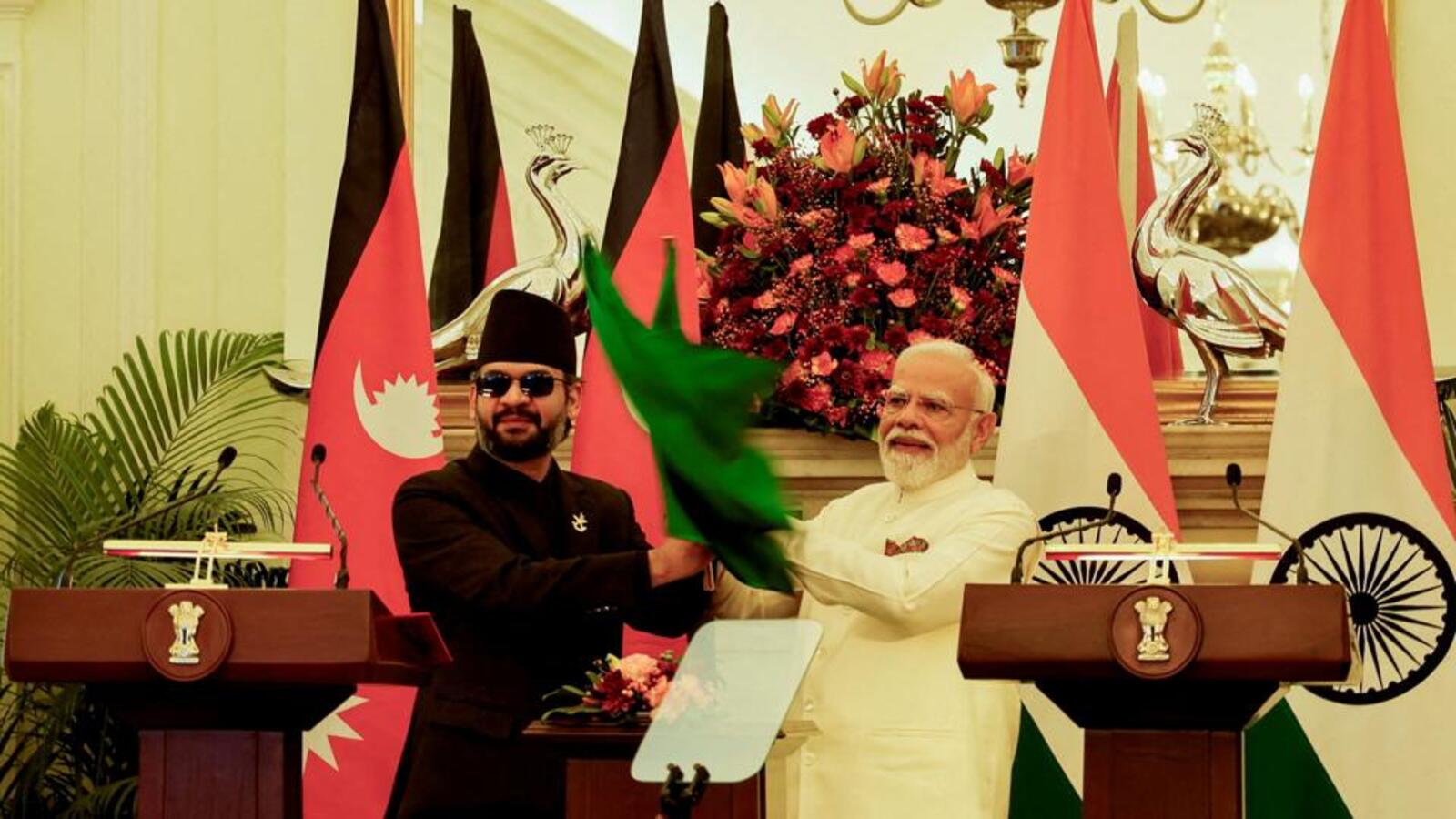
India on Monday announced a $1.6-billion economic development package for Nepal and unveiled a new joint vision with Prime Minister Narendra Modi and his Nepalese counterpart Balendra Shah pledging to reset long-standing ties.
Shah, 36, who came to power in elections earlier this year following a Gen Z uprising in 2025, was on his first bilateral foreign visit. After a ceremonial welcome at the Rashtrapati Bhavan, he held talks with Modi on bolstering Nepal's economy and reconstruction efforts following the August flash floods. Modi announced a package of Nepali ₹24,000 crore (Indian ₹15,120 crore or $1.6 billion) for Nepal's reconstruction and long-term development after the Bhote Koshi flash floods. Nepal had proposed a $2-billion package, half of it in grants, ahead of the visit.
The two sides launched the Saryu-Kamala Express weekly cross-border train service linking Ayodhya and Janakpur, and said they would enhance connectivity between Buddhist and Hindu sacred sites including Lumbini and Bodhgaya. A bridge over the Mahakali river linking Uttarakhand with Nepal was inaugurated and the foundation stone laid for an integrated check post at Banbasa. Modi said India would provide access to the Kandla and Paradip ports for Nepal's transit trade.
The foundation stone was laid for the 669-MW Lower Arun hydroelectric project, and India committed to timely completion of the Arun-3 project. Phase II of the Motihari-Amlekhganj pipeline was inaugurated and the foundation stone laid for the Jhapa petroleum terminal. Modi said India would establish a start-up incubator, an innovation hub and an offshore campus of the Indian Institute of Technology in Nepal, and expand scholarships in law and technology for Nepali students. The joint vision document carries the theme of "developed India and prosperous Nepal".