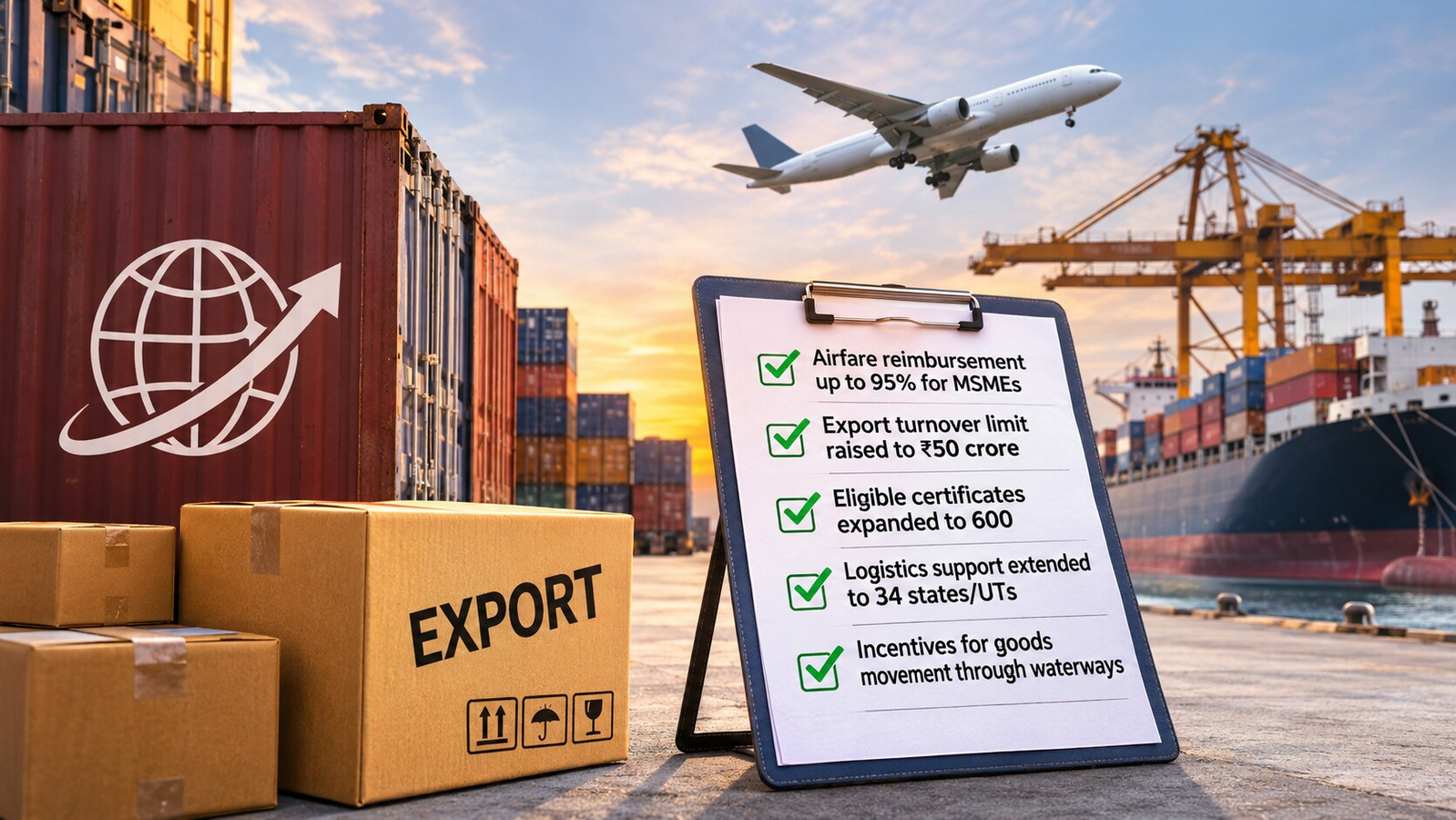
The Commerce Ministry has revised guidelines under the ₹25,060 crore Export Promotion Mission to give exporters broader access to international trade events, market access and logistics support, according to an official statement issued on Wednesday. The changes are intended to bring more exporters within the fold of assistance for participation in international trade events, reimbursement of certification costs and freight-related expenses. The Department of Commerce has amended guidelines covering Market Access Support, Trade Regulations, Accreditation and Compliance Enablement, and Logistics Interventions for Freight and Transport (LIFT) under the Niryat Disha sub-scheme.
Under the revised Market Access Support norms, the maximum export turnover threshold for airfare reimbursement has been raised from ₹75 lakh in the previous financial year to ₹50 crore. The government will reimburse up to 95% of airfare for micro and small exporters and up to 80% for other eligible exporters taking part in buyer-seller meets, trade fairs and trade delegations. The intervention is aimed at strengthening India's access to international export markets through such activities.
The list of certificates eligible for reimbursement has been expanded from 462 to 600, a move intended to support a wider group of MSMEs in meeting internationally recognised quality, safety and technical requirements. The Trade Regulations, Accreditation and Compliance Enablement intervention assists MSMEs in obtaining quality-related and compliance certifications required for international standards.
Under LIFT, support for low-export-intensity districts has been extended from 13 states and Union Territories to 34. Eligible destinations for transport reimbursement now include Land Customs Stations and Integrated Check Posts, and the revised guidelines add incentives for moving goods through waterways alongside existing support for road, rail and air transport. Air freight support for export shipments has been extended to Jammu and Kashmir and Ladakh, which were not covered earlier, while the North Eastern Region was already included. The intervention seeks to address geographical disadvantages and logistics gaps faced by MSMEs in low-export-intensity regions by helping reduce freight and transportation costs arising from their location.