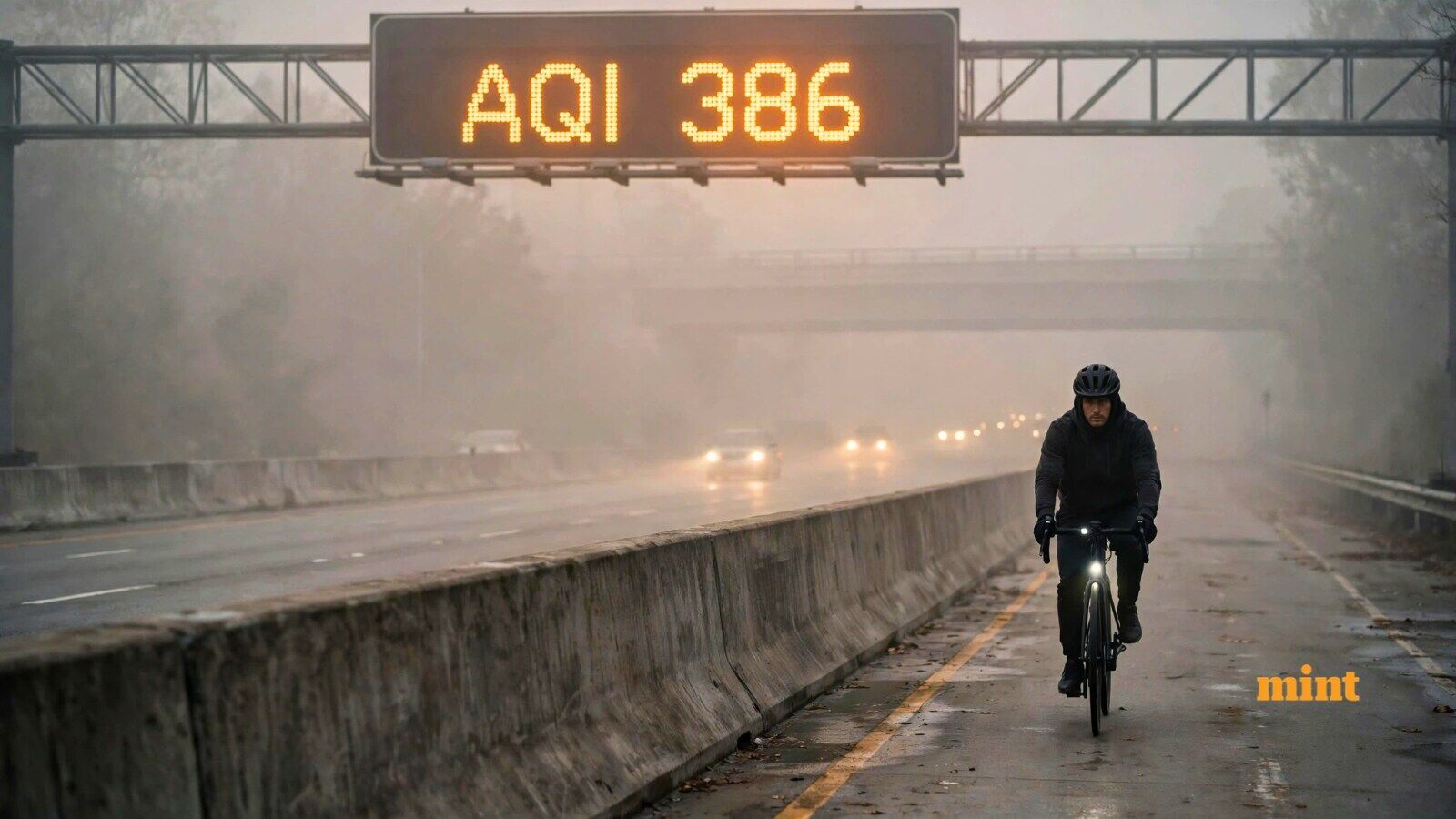
Delhi's Air Quality Index stood at 386 at 8:31 AM on Sunday, 22 November, placing the capital in the hazardous category on the US AQI scale, which begins at 301. Smoky haze accompanied the morning pollution, and New Delhi ranked 14th among the world's most polluted cities in the morning rankings. At the time of the reading, the temperature was 18°C, humidity 67%, wind speed 3.6 km/h and the ultraviolet index 0.5. Delhi's reading was 85 points above the hazardous threshold. PM2.5 concentration was 267 micrograms per cubic metre and PM10 was 374 micrograms per cubic metre. Carbon monoxide measured 2,105 parts per billion, nitrogen dioxide 16 parts per billion, sulphur dioxide six parts per billion and ozone two parts per billion.
Among eight Indian metros, Delhi recorded the highest AQI in the morning comparison. Chennai followed at 240, Mumbai at 210, Pune at 207 and Bengaluru at 205. Ahmedabad stood at 195 and Hyderabad at 171, while Kolkata had the lowest reading at 109. Four of the other seven metros recorded readings above 200.
Delhi's AQI had eased over the three days before Sunday's reading, standing at 353 on 19 November, 341 on the 20th and 313 the following day, a 40-point fall over two days. Sunday's live reading was 73 points above Saturday's daily figure. Earlier, Delhi recorded 666 on 9 November and 547 on 12 November, with the 9 November figure the highest daily reading through 21 November. The lowest was 224 on 17 November, followed by 273 on 18 November. Delhi recorded an AQI above 300 on 18 of the first 21 days of November, with all three days below 300 falling between 15 and 18 November.
Using Berkeley Earth's method, the AQI.in tracker estimated exposure equivalent to smoking 8.7 cigarettes daily, based on the average PM2.5 concentration over the previous 24 hours and assuming continuous exposure. At that rate, a week of continuous exposure would be equivalent to 60.9 cigarettes, an estimate, while the live AQI of 386 describes the air quality at the morning update.