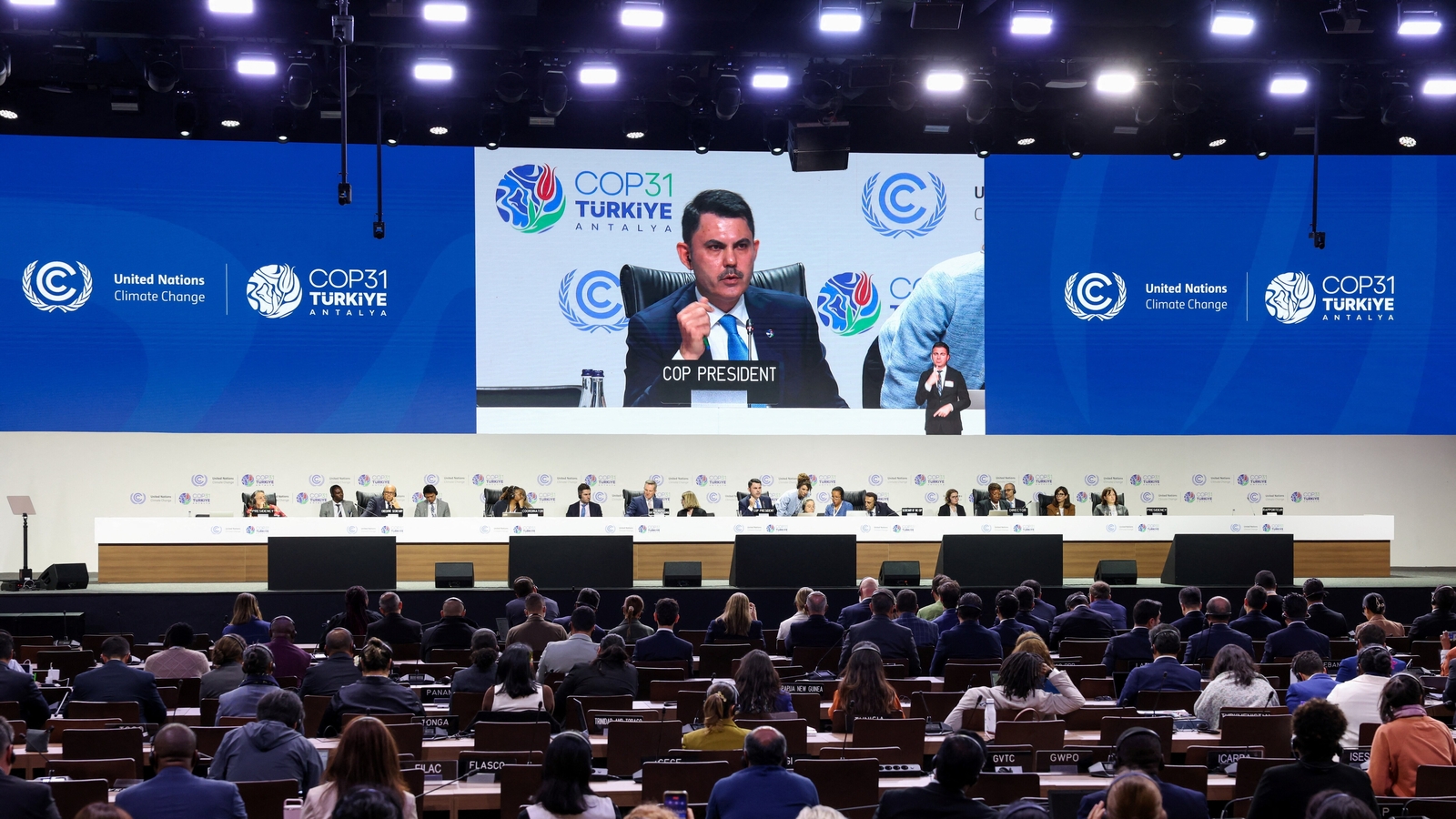
The COP31 climate summit in Antalya closed on Sunday without adopting its cover decision, after talks ran more than 44 hours past the scheduled Friday close and countries failed to bridge differences over fossil fuels, climate finance and equity. Nearly 200 countries could not agree on the proposed Antalya Pact, a setback for the Turkish and Australian presidencies. The European Union, the United Kingdom and several developing countries, including vulnerable island nations, opposed the final draft because it did not explicitly mention fossil fuels or commit to a clear pathway away from them.
It was the first time since COP15 in Copenhagen in 2009 that a summit's cover decision was not formally adopted, and the first such failure since the Paris Agreement was adopted in 2015. It was also the longest COP yet, beating the record set by COP25 in Madrid in 2019. At the closing plenary, COP31 president and Turkish environment minister Murat Kurum said there was no consensus on the document and that the decisions had therefore not been adopted. Ireland's climate and environment minister Darragh O'Brien, speaking for the EU, formally objected, saying the bloc would not endorse a cover decision that did not even mention fossil fuels, the key driver of climate change.
India, speaking for the Like-Minded Developing Countries, said the group had reservations about parts of the cover decision but had engaged with the presidency until the final stages and remained prepared to move forward. It flagged inadequate reflection of equity and the principle of common but differentiated responsibilities and respective capabilities, particularly in paragraphs introducing new global targets, and objected to what it called the dilution of developed countries' historical responsibility. Panama also rejected the text, with its chief climate negotiator Ana Aguilar saying it repeated existing commitments without closing the gap between current action and what science demanded.
The fossil fuel dispute was the central fault line, with Saudi Arabia and Russia resisting stronger language on moving away from oil, gas and coal, while more than 130 countries wanted the text to restate the transition agreed at COP28 in Dubai in 2023. On climate finance, the final text recalled Article 9.1 of the Paris Agreement but attached no new quantified commitments, and the call to at least triple adaptation finance by 2035 still had no agreed baseline. The draft retained an ambition to raise electricity's share of global final energy consumption to 35% by 2035 and to scale up carbon capture, utilisation and storage to gigatonne level by the same year, a focus campaigners argued risked diverting attention from direct emission cuts.